The best football boots for a wet, muddy natural-grass pitch are SG boots when the soil is soft enough to accept longer studs; FG boots remain suitable when rain has made the surface damp but the ground is still firm. Choose from actual stud penetration, pitch rules and model fit—not weather alone.
Wet-pitch quick answer
- Damp but firm natural grass: FG can remain appropriate.
- Soft, loose or muddy natural grass: SG is the specialist starting point.
- Water on a hard base: longer studs may not enter; inspect the soil.
- Artificial grass after rain: keep using an approved AG/MG plate, not SG.
- Metal studs: confirm competition and referee approval.
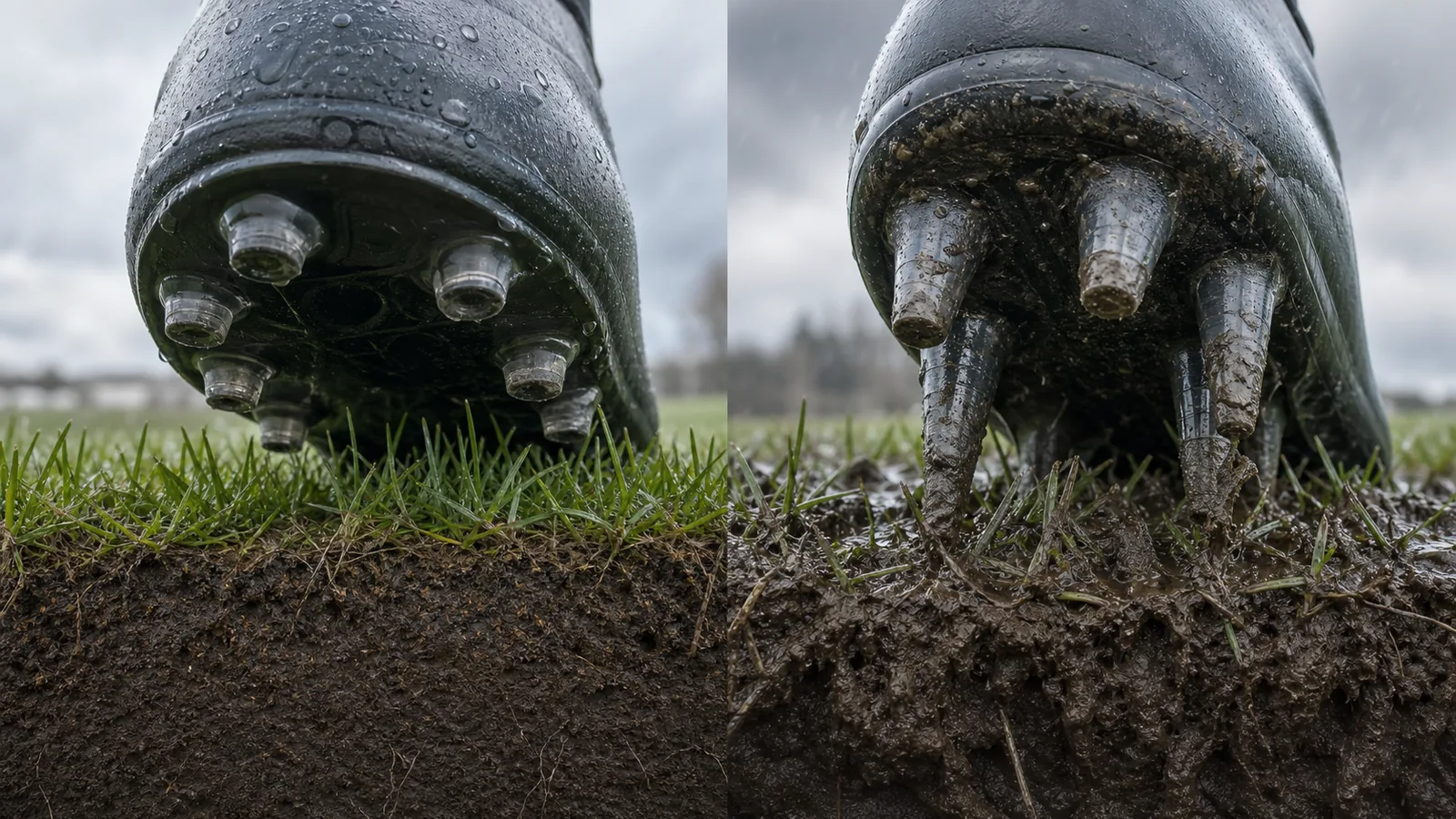
FG vs SG for wet grass
| Condition | FG football boots | SG football boots |
|---|---|---|
| Dry, firm natural grass | Designed for it | Studs may not enter comfortably |
| Slightly damp but firm grass | Often still suitable | Usually unnecessary |
| Soft, wet natural grass | Shorter studs may clog or slip | Designed for deeper penetration |
| Deep mud | May lose traction | Specialist option, subject to rules |
| Artificial grass in rain | Only if approved for that pitch | Not the correct default |
How do you know when the ground is soft enough for SG?
Soft ground accepts a longer stud into the soil without forcing the player to balance on top of the stud tips. Check a safe area beside the playing surface and follow the groundskeeper or referee’s assessment. Visible rain is not enough: drainage, soil construction and previous weather can leave one pitch soft and another firm.
- Confirm the surface is natural or approved hybrid grass, not artificial turf.
- Look for loose soil, mud and grass movement underfoot.
- Press a stud into a non-playing edge without damaging the pitch.
- Ask whether metal-tipped or removable studs are permitted.
- Warm up and stop if pressure is concentrated or release feels abnormal.
What are SG football boots?
Soft-ground boots use longer studs to enter wet, loose natural soil and create traction where a firm-ground pattern may not penetrate enough. Many SG plates use removable metal-tipped studs or a mixed layout, but not all SG boots are identical. Read the outsole designation and stud-care instructions for the exact model.
Browse soft-ground football boots only after confirming that wet natural grass is your recurring condition. SG is a specialist purchase, not a universal second pair.
When is FG still better after rain?
FG remains the better option when natural grass is damp at the surface but the soil beneath is firm enough for moulded studs. A well-drained pitch can be wet without becoming soft ground. If long SG studs cannot enter, they may feel unstable or create obvious underfoot pressure.
The complete FG, AG and SG guide explains the full surface decision. Browse firm-ground football boots for regular dry-to-damp natural grass.
Do longer studs always provide more grip?
No: longer studs provide useful traction only when the ground can accept their penetration. On a hard base, the studs may sit on top of the surface rather than enter it. Grip also depends on stud spacing, shape, pitch condition and the player’s movement.
Correct principle: choose enough penetration for the soil condition, not the longest stud available.
Are metal studs allowed in football?
Metal studs may be allowed in some competitions, but they are subject to safety inspection and local restrictions. IFAB Law 4 states that a player must not use dangerous equipment. The referee can reject unsafe, damaged or sharpened studs, and venues—especially synthetic facilities—can prohibit metal entirely.
- Inspect removable studs for tightness before play.
- Replace worn, burred or damaged tips.
- Do not mix lengths unless the manufacturer specifies the configuration.
- Carry the correct stud key if the design is removable.
- Check youth, school and local competition rules separately.
What upper works best in wet conditions?
Choose the upper that fits securely and can be maintained after wet play; no material makes the wrong soleplate suitable. Synthetic uppers can be easier to clean consistently, while natural leather needs careful drying and conditioning according to its care instructions. Avoid direct heat for both.
After a wet match, loosen and remove the laces, take out removable insoles, brush away mud and air-dry at room temperature. Follow the full football boot cleaning guide.
Wet-pitch buying checklist
- The surface is natural grass, not artificial.
- The soil is soft, not merely wet on top.
- The competition allows the stud material and layout.
- The boot fits securely with the socks used in wet weather.
- Studs can be inspected, cleaned and tightened.
- You have FG available for firmer conditions if the pitch dries.
Common mistakes on muddy pitches
Using SG on artificial grass because it is raining
Rain does not turn artificial grass into soft natural ground. Continue with the artificial-surface plate approved by the facility.
Choosing SG from a weather forecast alone
Drainage and soil determine the pitch condition. Inspect on arrival and follow the official decision.
Leaving mud on removable studs
Dried soil can hide wear and make removal difficult. Clean, dry and inspect the outsole after use.
Drying boots on a radiator
Direct heat can damage adhesives, coatings and upper materials. Air-dry at room temperature.
Frequently asked questions
Are SG boots only for mud?
SG boots are for soft natural ground, which can be wet, loose or muddy. Deep visible mud is not required if the soil is soft enough for the longer studs.
Can you wear FG boots in the rain?
Yes when the natural-grass pitch remains firm or only slightly damp and the FG plate still penetrates appropriately. Change to SG when the soil becomes soft and the rules permit it.
Can you wear SG boots on firm ground?
SG is not recommended by default on firm ground because the longer studs may not enter, which can concentrate pressure and reduce stability.
Can you use SG boots on 3G?
No by default. Use AG or a venue-approved MG plate on 3G. Many artificial facilities prohibit metal studs.
Should defenders wear SG more often?
Position does not decide the soleplate. Every player on the same soft natural pitch can need surface-appropriate traction; fit and movement preference then decide the model.
Sources and next step
Reviewed July 27, 2026 using the adidas surface guide, IFAB Law 4 and FIFA’s natural, hybrid and artificial pitch definitions. Continue with the football boot soleplate guide, then use the football boots buying guide to choose fit and upper.