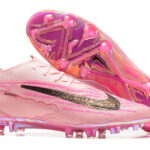
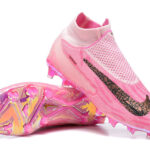
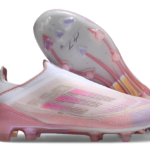
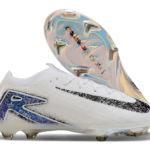
The right football boots are the pair that match your main playing surface, foot shape and fit before they match your favourite player or colourway. Start with the soleplate, confirm a secure but pain-free fit, then compare upper, closure and price tier. This order prevents the most common buying mistake: choosing a desirable model that is wrong for the pitch or foot.
Football boot buying guide: quick answer
- Choose the surface: FG for firm natural grass, AG for modern artificial grass, SG for soft natural grass, TF for short carpet-style turf and IN/IC for flat indoor courts.
- Check the fit: the heel and midfoot should stay secure, while the toes should lie naturally without numbness or sharp pressure.
- Match the foot shape: do not buy extra length to solve a width problem.
- Choose a closure: laces give more adjustment; laceless boots depend more heavily on the boot already matching your foot.
- Set a realistic tier: fit and the correct soleplate matter more than an Elite label.
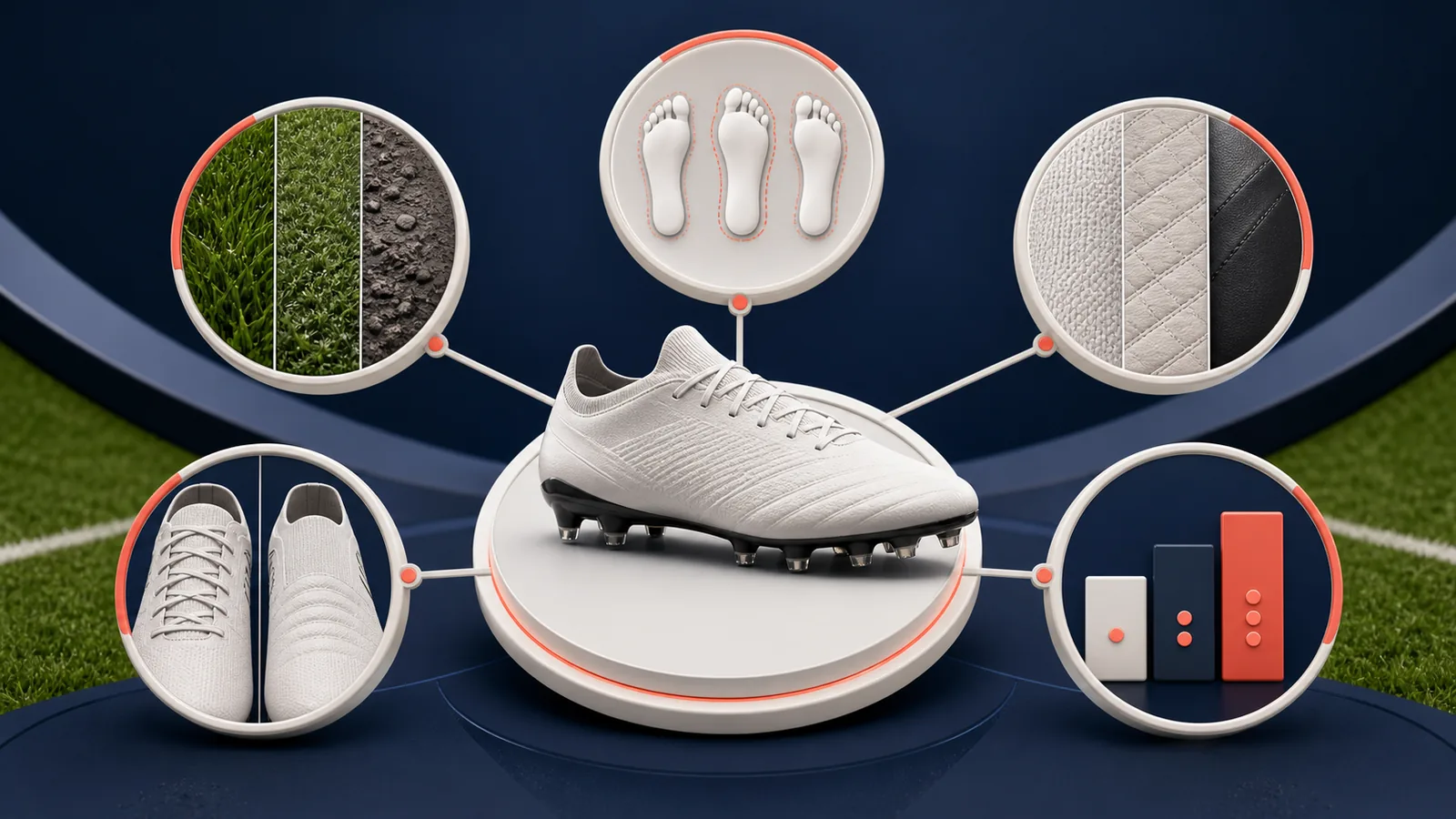
1. Choose the correct football boot soleplate
The surface is the first buying decision because the outsole controls how the boot interacts with the pitch. Adidas identifies FG as a natural-grass option and AG as the specialist option for artificial grass; its current buying guide also separates MG, turf and indoor footwear. Pitch condition matters as much as the broad surface name, so inspect where you actually play rather than ordering from a product photo.
| Label | Designed for | Typical outsole | Do not treat as |
|---|---|---|---|
| FG | Firm, short natural grass | Moulded studs with moderate penetration | A universal plate for every pitch |
| AG | Modern long-pile artificial grass | Shorter, often more numerous studs | The same thing as short carpet turf |
| SG | Soft, wet or muddy natural grass | Longer studs, sometimes removable or mixed | A traction upgrade for hard ground |
| MG | Multiple approved surfaces | Brand-specific moulded layout | Permission to use the boot everywhere |
| TF | Short, hard, carpet-style turf | Many small rubber lugs | A long-pile AG plate |
| IN/IC | Flat indoor courts | Non-studded rubber outsole | An outdoor grass boot |
Read the complete football boot soleplate and surface guide if you are unsure. You can then browse firm-ground boots, artificial-ground boots or soft-ground boots by the surface you use most.
Buying rule: do not select studs because they look aggressive. Select the outsole that the manufacturer and venue identify for your pitch.
2. Find the right football boot fit and size
Football boots should feel close around the heel and midfoot without forcing the toes to curl or creating numbness, burning or sharp pressure. A small amount of usable space at the front is normal; adidas currently describes up to a quarter inch, while Nike advises recreational players to start with their regular shoe size and the socks used for play. Model shape still varies, so a brand-wide sizing shortcut is less reliable than measuring and checking the individual boot.
Use this fit test before keeping a pair
- Heel: walk, jog and make a controlled cut; obvious heel lift means the rear fit is not secure.
- Midfoot: the boot should hold the foot without crushing the instep.
- Forefoot: the widest part of the foot should sit inside the widest part of the boot.
- Toes: they should lie naturally and should not hit the end when stopping.
- Socks: try boots with the same thickness you use in training or matches.
- Both feet: size for the larger foot if your feet differ.
For a more detailed home check, use How Should Football Boots Fit?. When comparing regional sizes, use the EU-to-UK/US football boot size converter, but confirm the manufacturer chart because EU increments are not perfectly uniform between brands.
3. Match the boot to your foot shape
Width is a shape problem, not a length problem. Going up a full size may reduce side pressure, but it can also create excess toe room and heel movement. Wide-footed players should compare forefoot volume, midfoot wrap and instep height rather than relying only on a “true to size” label.
Nike’s May 2026 fit guide describes Mercurial as a more contoured, narrow fit and Phantom and Tiempo as more natural, roomier starting points. That is useful model-family guidance, not a guarantee for every foot. Our wide-feet football boot guide explains how to compare these shapes with laced Adidas Predator options without pretending that one family fits everyone.
Signs the boot is too narrow
- The foot spills over the soleplate edge.
- The upper creates sharp pressure at the little-toe joint.
- The toes become numb during a short indoor fit check.
- You must loosen laces completely and still feel compressed.
Signs the boot is too long
- The heel lifts after tightening the laces.
- The foot slides forward during a stop.
- There is a large empty fold above the toes.
- You catch the toe when walking or striking the ball.
4. Compare football boot upper materials
Upper material changes the feel, structure and care requirements of a boot, but material alone does not determine quality. Modern synthetic, knit and synthetic-leather uppers can be engineered for very different levels of softness and structure. Natural leather can conform with wear, while many current synthetics are designed to feel consistent earlier in their life.
| Upper type | Typical strengths | Trade-offs to check | Good starting point for |
|---|---|---|---|
| Natural leather | Supple feel; can conform to the foot | May absorb more moisture; needs careful drying and maintenance | Players prioritising a traditional touch |
| Synthetic leather | Consistent construction; often easier to maintain | Stretch and softness vary widely by model | Comfort-focused modern boots |
| Thin synthetic | Close touch and lower bulk | Can expose pressure points if the shape is wrong | Players who like a barefoot-style feel |
| Knit or textile-based | Flexible wrap and engineered support zones | Collar and midfoot tension can be hard to judge online | Players who prefer a sock-like wrap |
Do not assume that leather is automatically wide or that synthetic is automatically narrow. The last—the three-dimensional shape around which the boot is built—usually matters more than the category name.
5. Choose laced or laceless football boots
Laced boots are the safer default when you need adjustable lockdown; laceless boots work best when the fixed shape already matches your foot. Laces can change tension across the forefoot and instep. A laceless boot relies on the upper, collar and internal structure, so excess volume is harder to correct.
| Question | Laced | Laceless |
|---|---|---|
| Can lockdown be adjusted? | Yes, across several eyelets | Limited; depends on upper tension |
| Is it forgiving for unusual instep volume? | Usually more adaptable | Less forgiving if the shape is mismatched |
| Is the striking area cleaner? | Laces remain present, sometimes offset or covered | No exposed laces |
| Does it guarantee better touch? | No | No |
See Laceless vs Laced Football Boots for the full comparison. If you have a high instep, low-volume foot or history of heel slip, the ability to tune lacing is particularly valuable.
6. Decide how much to spend on football boots
Buy the lowest price tier that gives you the correct surface, reliable fit and construction suitable for your playing frequency. Elite boots may use lighter or more specialised materials, but they do not correct the wrong stud pattern or an incompatible shape. A well-fitting mid-tier boot is a better purchase than a painful premium pair.
Match spending to use
- Occasional player: prioritise a durable soleplate and comfortable upper before weight.
- Weekly player: compare mid-tier models with replaceable insoles, secure heel structure and the correct surface plate.
- Frequent competitive player: premium materials may be worthwhile if you already know the model shape fits you.
- Multi-surface player: two appropriate pairs can be more useful than one expensive pair used on the wrong pitches.
Inspect the returns policy before ordering, especially for laceless, narrow or limited-edition models. Colour and scarcity can raise the price without changing suitability.
7. Choose by playing style, not position alone
No football position requires one specific boot family. Nike’s current fit guide explicitly says its boot lines can be worn in every position. Foot shape and surface remain the constraints; playing style helps decide between suitable options after those two checks.
| Preference | Features to compare | Relevant guide |
|---|---|---|
| Close, speed-oriented feel | Secure heel, low-volume wrap, responsive plate | Nike Mercurial vs Adidas F50 |
| Winger movement | Fit during cuts, surface-correct traction, low distraction | Best Football Boots for Wingers |
| Defender comfort and control | Stable lockdown, predictable grip, comfortable upper | Best Football Boots for Defenders |
| Wide-foot comfort | Forefoot volume, adjustable closure, heel hold | Best Football Boots for Wide Feet |
8. Break in and care for the boots correctly
Correctly sized modern boots should not require painful stretching. Begin with a short indoor check, then use the boots in controlled training before a full match. Sharp pressure or numbness is evidence to reassess the size or shape, not a challenge to endure.
Follow the safe football boot break-in plan. After play, remove loose dirt, hand-clean with mild solution when needed and air-dry away from direct heat using the football boot cleaning guide.
9. Final football boot buying checklist
- Write down the surface you use most and its usual condition.
- Choose only soleplates approved for that surface.
- Measure both feet and use the larger measurement.
- Check the model’s shape, not only the brand’s general sizing reputation.
- Try the boots with match socks and any orthotic or performance insole you use.
- Test heel hold, toe position and forefoot pressure indoors.
- Choose laces if you need more adjustment.
- Confirm the seller’s authenticity information and returns process.
- Keep the packaging and do not train outdoors until the indoor fit is acceptable.
If authenticity is a concern, use 10 practical checks for fake football boots. No single QR code, label or logo proves authenticity; compare several signals and the seller’s return terms.
Football boots buying cluster
Use the main guide for the buying sequence, then open only the specialist guide that answers your next decision:
- Surface and soleplate guide — FG, AG, SG, MG, TF and indoor.
- Complete fit guide — heel, midfoot, width and toe room.
- Wide-feet guide — model shape and adjustable options.
- EU, UK and US size converter — brand-specific conversion tables.
- Laced vs laceless — lockdown, touch and instep volume.
- Break-in guide — a gradual three-session plan.
- Cleaning guide — care without washing-machine or heat damage.
Frequently asked questions
What should I look for when buying football boots?
Check the playing surface first, then fit, foot shape, upper, closure and price tier. The soleplate must suit the pitch, and the heel and midfoot should stay secure without painful toe or forefoot pressure.
Should football boots be tight?
Football boots should be snug, not painful. A secure fit limits heel movement and excess sliding, but numb toes, sharp pressure or curled toes indicate that the size or shape is wrong.
Are expensive football boots worth it?
Expensive boots can offer lighter or more specialised materials, but value depends on fit, surface and frequency of use. A correctly fitted mid-tier boot on the right soleplate is more useful than an Elite boot on the wrong surface.
Can one pair of football boots be used on every surface?
No single pair is suitable for every surface. Some manufacturer-approved MG models cover more than one pitch type, but SG, AG, TF and indoor outsoles solve different traction and pressure requirements. Check the exact model and venue rules.
Should beginners buy laced or laceless football boots?
Laced boots are usually the safer starting point because the player can adjust lockdown across the instep and forefoot. A laceless boot is reasonable when its fixed shape already holds the heel and midfoot securely.
Sources and review method
This guide was reviewed on July 27, 2026. Recommendations are based on surface compatibility, fit logic and current manufacturer guidance rather than claimed hands-on testing. Primary references include the adidas soccer cleat buying guide, Nike’s 2026 fit guide, the FIFA Quality Programme for Football Turf and the IFAB Law 4 equipment safety rule. Product labels and venue rules remain authoritative for a specific pair and pitch.
Shop by playing surface
Start with the pitch you use most, then compare fit and size on the product page.
Firm Ground · Artificial Ground · Soft Ground · All Football Boots